Google Ads management pricing what it actually costs in 2026
What agencies, freelancers, in-house hires and software charge to run Google Ads in 2026, the pricing models behind those numbers, and the ad spend at which each option starts to make sense. Every figure below was read at its own source and dated.
 Google Ads and lead generation, 12 years 18 min read Updated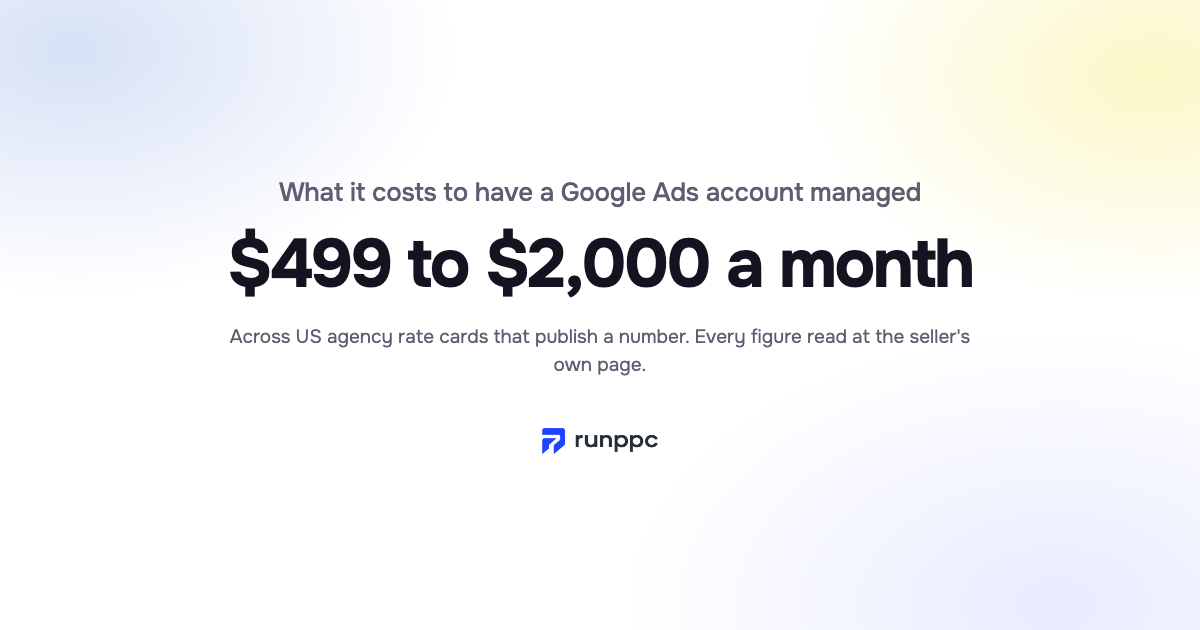
Running Google Ads has two costs that people constantly confuse: what you pay Google for clicks, and what you pay a person or a tool to manage the account. This page is about the second one. Across the US agency rate cards that publish a number, monthly management runs about $499 to $2,000 for a small account, and 10% to 20% of ad spend once spend passes roughly $5,000 a month, falling as spend rises. Software that helps you run the account yourself starts between $27 and $249 a month.
Which option is right for you depends almost entirely on how much you are spending on ads.
- If you are spending under $2,500 a month on ads A management fee usually costs more than it saves, and software plus your own attention is the better trade.
- If you are somewhere between those two numbers It is a genuine judgment call about what your own time is worth.
- If you are spending above roughly $10,000 a month A specialist almost always pays for themselves.
Every price read at its own source on
Who wrote this. The team that builds RunPPC, which is Google Ads software and is priced further down this page alongside everything else. We are obviously not neutral about it. What we have done instead of claiming neutrality is source every third-party number here from that company's own pricing page, date it, and say so when sources disagree. No agency is ranked, scored or compared against our product anywhere on this page.
The three things you are actually paying for
Lumping these together is how people end up surprised by a quote. Separate them before you compare anything.
-
Ad spend
Goes to Google
What you pay Google every time someone clicks. This is usually the biggest of the three, and it is the only one that buys you traffic directly. In a sample of 251,236 audits run by 15,666 Google Ads accounts, the average account spent about $3,127 a month, with 24% under $1,000 and 37% over $10,000.
WordStream Performance Grader, collected 1 January to 17 November 2025. Self-selected sample of advertisers who chose to audit their own account.
-
Management fee
Goes to whoever runs it
What you pay a person, an agency or a tool to decide where that budget goes. This is the number this page is about. It is quoted as a flat monthly fee, a percentage of your ad spend, or some combination of the two, and the model matters more than the headline number.
-
Setup and onboarding
Usually one-time
Quoted separately by most agencies that publish anything at all. Third Marble charges $399 on top of the monthly fee. LYFE Marketing lists $300, annotated "Call us to waive". Emprise Digital charges a $2,000 build fee. WebFX bills $1,200, $2,250 or $5,800 by tier, though it labels that as first month's management including a campaign audit rather than a setup fee.
Read from each company's own pricing page on 23 August 2026.
The six ways management is priced
Agency pricing turns on the model more than the headline number, because two agencies quoting "15%" can charge you very different amounts. Published rate cards and agency guidance are reported separately below, since they disagree by as much as four times on the same account.
-
Percentage of ad spend
- How it works
- Your fee is a stated share of what you spend on ads, recalculated monthly. Almost always paired with a minimum, worded "whichever is greater".
- What it runs
- 10% to 20% is the common position across six 2026 guides. US agencies that publish an actual percentage sit at the low end: Logical Position 10% to 12%, WebFX 12% to 15%, Emprise Digital 10%.
- Who prices this way
- Accounts spending roughly $5,000 a month and up. Below that, no published US rate card we read uses it at all.
- What to check
- Every source we checked says the percentage falls as spend rises. If a quote does the opposite, ask why. Also confirm whether it is calculated on ad spend alone or on spend plus fee.
-
Flat monthly retainer
- How it works
- One fixed fee, independent of ad spend. Tiers are gated either by a spend ceiling or by workload counts such as campaigns and keywords.
- What it runs
- $499 to $2,000 a month across the published US rate cards: Third Marble from $499, LYFE Marketing $500 to $1,400, Logical Position $599, WebFX Lite $750, Emprise Digital from $1,000, Hook Agency from $2,000.
- Who prices this way
- Small and local accounts, and shops that decline percentage pricing on principle.
- What to check
- What the flat fee is as a share of your budget, and where the tier's spend ceiling sits. A $599 fee that covers you to $4,999 of spend becomes a percentage the moment you cross it.
-
Flat floor, percentage above it
- How it works
- You pay the larger of a minimum fee and a percentage. The floor governs small accounts, the percentage governs large ones, and the crossover is arithmetic you can do yourself.
- What it runs
- WebFX publishes "$975 or 15% of spend, whichever is higher" on its Pro plan and "$4,500 or 12%, whichever is greater" on Enterprise.
- Who prices this way
- Agencies that want percentage economics on large accounts without losing money on small ones.
- What to check
- Find the crossover before you sign. WebFX's $975 floor is 19.5% of a $5,000 budget and only becomes a true 15% once spend passes $6,500.
-
Base fee plus a percentage
- How it works
- A flat base and a percentage, added together rather than compared.
- What it runs
- Third Marble's comparison page shows its own fee as "$549 ($499 + 5%)" on a $1,000 click budget, while its main pricing page says only "starts at $499 per month". The same company describes its price two ways.
- Who prices this way
- Small-account specialists wanting a predictable base with upside as clients grow.
- What to check
- The two components stack, so your effective rate is always above the headline percentage. Ask whether the base is a floor or an addition.
-
Tiered percentage ladder
- How it works
- The rate steps down as spend crosses thresholds. A flat ladder applies one rate to your whole spend; a marginal ladder applies each rate only to the slice inside its band. They bill very differently.
- What it runs
- Logical Position publishes a complete ladder: $599 flat to $4,999 of spend, 12% from $5,000 to $10,000, $1,200 flat to $12,000, then 10% to $90,000, with 5% off on a 12-month and 10% off on an 18-month agreement.
- Who prices this way
- Agencies serving a wide spend range from one rate card.
- What to check
- There is no standard threshold for where the taper starts. The only US ones we could verify first-hand are Emprise Digital at $10,000 of monthly spend and WebFX at $30,001.
-
Hourly and project work
- How it works
- Billed by the hour for audits, buildouts, training and advisory work rather than ongoing management.
- What it runs
- OuterBox puts PPC consulting at "$75 to $250+ per hour". Clutch lists $100 to $149 as a common band for PPC agencies in the US, Canada and Australia.
- Who prices this way
- One-off work only. We found no US agency selling ongoing Google Ads management by the hour.
- What to check
- Check the vintage on any hourly benchmark. The widely quoted "$150+ per hour" figure traces to a Credo survey page last updated in June 2022 that discloses no sample size.
A seventh structure sits under all of them: the minimum. Almost every percentage quote carries a floor, and at small ad spend the floor is what you pay, not the percentage. Ask for it explicitly.
What it costs at your size
Find your monthly ad spend and read across. The chart shows why the answer changes so much: a flat fee and a percentage cross over at about $5,000 a month, and below that a management fee is a very large share of a small budget.
- 12% of ad spend
- $599 flat retainer
- RunPPC software
| Monthly ad spend | Typical management fee | As a share of spend | What makes sense here |
|---|---|---|---|
| Under $1,000 | $300 to $600 | 50% to over 100% | Most agencies decline. WebFX states a minimum ad spend of $1,000 to $5,000; Third Marble's floor is $1,000 local, $3,000 national. At Logical Position's $600 spend floor its $599 fee is essentially the whole ad budget. Realistic options here are self-managing or software. |
| $1,000 to $2,500 | $499 to $800 | 20% to 75% | Flat fee, and only a flat fee. No published low-tier US rate card prices this band as a percentage, so the widely repeated "10% to 20% of ad spend" answer is describing a model that does not exist down here. Budget for onboarding on top. |
| $2,500 to $5,000 | $499 to $1,000 | 10% to 40% | Still flat-fee territory, and the band where flat and percentage converge. Logical Position's $599 works out to 24% at $2,500 of spend and 12% at $5,000. If you are quoted a percentage here, ask for the minimum monthly fee: the minimum is what you will actually pay. |
| $5,000 to $10,000 | $600 to $1,500 | 10% to 20% | The widest genuine disagreement in the market. Published rate cards land at $600 to $1,500 for this account while agency guidance says $1,500 to $5,000 for the same account, roughly a 4x spread. Get every quote in both forms. |
| $10,000 to $25,000 | $1,200 to $3,000 | 9% to 15% | Where percentage pricing genuinely becomes the norm and the taper begins. A specialist is straightforwardly worth it for most accounts at this level. |
| $25,000 to $50,000 | $2,500 to $6,000 | 9% to 15% | Tier boundaries create plateaus rather than cliffs. WebFX's fee is $4,500 at $30,000 of spend and still $4,500 at $30,001, sliding from an effective 15% to 12% without the headline rate changing. |
| $50,000 to $100,000 | $5,000 to $12,000 | 9% to 12% | The taper flattens and the negotiation stops being about the percentage. What matters is what sits inside it, since extra channels are commonly billed on top. |
| Over $100,000 | Mostly custom | 6% to 12% | Every US rate card we could read stops publishing here. Establish whether a quoted percentage is marginal, charged band by band, or flat across your whole spend. At this size the difference between those two structures is thousands a month. |
Our own read
From the accounts our agent watches: below roughly $2,500 a month in ad spend, a management fee usually costs more than it saves, and software plus your own attention is the better trade. Above roughly $10,000 a month, a specialist almost always pays for themselves. Between those two numbers it is a genuine judgment call about what your own time is worth. That is our position, not an industry statistic, and we have an obvious interest in one half of it.
What it costs to run it yourself
Software replaces the fee, not the decisions. These are entry prices read from each vendor's own pricing page; all of these ladders climb with your ad spend, so check the tier you would actually land in.
-
Adpulse
From $27/mo
billed annually, at $5,000 of monthly ad spend ($33 monthly)
-
Adzooma
Free, then $69/mo
Silver $69/mo or $700/yr, Gold $179/mo. Tiered on features, not ad spend
-
Adalysis
From $149/mo
billed monthly, up to $50,000 of monthly spend ($126 on annual billing)
-
Optmyzr
From $209/mo
Essentials billed annually, up to $25,000 monthly spend and 25 accounts ($299 billed monthly)
-
TrueClicks
Free, then $249/mo
free up to $50,000 of monthly ad spend, paid plans from $249/mo billed monthly
Where RunPPC sits
RunPPC is our own software, so treat this as the interested party speaking. It is $49 a month for one account up to $3,000 of monthly ad spend, $99 with no spend ceiling and a daily review, and $199 for up to three accounts in one dashboard, month to month. The agent reads your account, works out what is pushing your cost per lead up, and proposes the exact changes for you to approve. It proposes, you approve, and RunPPC applies that exact version in your Google Ads account. Nothing is sent to Google Ads any other way, and a new campaign is always created paused, so starting it stays your decision.
-
Pro
$49/mo
For the business owner running their own Google Ads.
-
Max
$99/mo
For the owner who wants more leads out of the same budget.
-
Multi
$199/mo
For anyone running more than one Google Ads account.
The honest limit of any tool in this section, ours included: none of it can optimize toward leads you are not measuring. If your calls and form submissions are not tracked correctly, start with conversion tracking before you buy anything at all. And for what each of these tools is genuinely best at, we keep a full comparison of AI tools for Google Ads.
Grow my Google AdsAnd hiring instead? There is no federal wage series specific to paid search. The closest proxy, market research analysts and marketing specialists, reports a US median of $78,760 (Bureau of Labor Statistics, May 2025 reference period). Commercial salary sources disagree by more than a factor of two and should not be averaged, but the two largest samples land in the high $70,000s to low $80,000s. Applying the Bureau's own split between wages and benefits, which is our arithmetic and not a published multiplier, that is roughly $113,000 to $116,000 a year fully loaded, or about $9,400 to $9,700 a month, before desk, software, recruiting or management time.
When paying someone is the right answer
We sell software, so read this section with that in mind. It is here because the honest answer to "should I pay someone" is yes more often than a software company's website usually admits.
-
Your ad spend is above roughly $10,000 a month
This is the clearest line on the whole page. At $10,000 of monthly spend a 12% fee is $1,200. If a specialist finds even a 15% improvement in cost per lead, the fee has paid for itself and then some. Percentage pricing exists at this level precisely because it works for both sides.
-
Your time is genuinely worth more than the fee
If you bill $200 an hour and running the account costs you six hours a month, you are spending $1,200 of your own capacity on it. A $2,000 retainer at $10,000 of spend is not a cost in that situation, it is arbitrage. Do this arithmetic honestly before deciding anything.
-
You are running several locations, brands or accounts
Complexity scales worse than spend does. Multi-account structures, shared budgets, cross-location cannibalisation and franchise rules are exactly the kind of work where someone who has done it fifty times before is worth paying, and where a first-timer loses money learning.
-
Your competitors are running genuinely well-managed accounts
In the expensive lead-gen categories you are bidding against people who have professionals doing this, and a learning curve costs more in those auctions than in cheap ones. Attorneys run a $9.87 median cost per click, home improvement $8.33, dentists $8.00, across 13,474 US campaigns from April 2025 to March 2026. Two caveats the source states itself and most citations drop: those are medians rather than averages, and the dataset covers Microsoft Ads alongside Google Ads.
Agency, freelancer, in-house or software
The same five questions asked of each option. These are categories, not companies: any individual agency or freelancer can be much better or much worse than the row that describes them.
| Agency | Freelancer | In-house hire | Software | |
|---|---|---|---|---|
| What it costs | $499 to $2,000/mo at small spend; 9% to 15% of spend above roughly $10,000, plus setup | Varies widely. We found no US freelancer retainer figure we could verify at a primary source, so we are not quoting one | Roughly $113,000 to $116,000 a year fully loaded, or about $9,400 to $9,700 a month, plus tooling | $27 to $249/mo across the tools that publish a price. RunPPC is $49, $99 or $199 |
| What you still do | Approve strategy, supply business context, review reporting | The same as with an agency, plus more of the coordination | Manage a person: hiring, review, cover, career | Review what it proposes, edit any part of it, and approve it. RunPPC then makes the approved change in your account. You stay the decision-maker |
| How fast it moves | Fast once onboarded, slower to start (setup and audit period) | Often the fastest to start, no onboarding machinery | Fastest of all once they know the business | Immediate, no onboarding period |
| When it goes wrong | You have a named person accountable, and a contract behind it | One person, so holidays, illness and churn are real risks | You carry it. Recruitment, ramp-up and replacement are all yours | No one to call at 6pm. Every change is recorded, but the accountability stays with you |
| Who it suits | Spend above roughly $10,000 a month, multi-location, or anyone whose time is worth more than the fee | Small and mid accounts wanting a specialist without agency overhead | Large or complex programmes where paid search is a core function, not a channel | Spend below roughly $5,000 a month, or anyone who wants to keep the account in their own hands |
If you are weighing software specifically against what Google now offers inside the platform at no extra cost, that comparison has its own page: Google's Ask Advisor, and where it stops.
Frequently asked questions
How much does Google Ads management cost per month?
Across the US agency rate cards that publish a number, monthly management runs about $499 to $2,000 for a small account. Once ad spend passes roughly $5,000 a month, pricing switches to a percentage, commonly 10% to 20% of ad spend, falling as spend rises. Software that helps you run the account yourself starts between $27 and $249 a month. Setup or onboarding is usually charged separately, commonly $300 to $2,000.
Is 15% of ad spend a fair management fee?
It is within the normal band, but the number alone does not tell you much. 15% of $10,000 is $1,500 and 15% of $2,000 is $300, which no agency will accept, so at small spend the minimum fee is what you actually pay, not the percentage. Ask two questions of any percentage quote: what is the minimum monthly fee, and does the percentage fall as spend rises. Every US agency we checked that publishes a rate reduces the percentage at higher spend.
How much should a small business pay someone to run Google Ads?
If you are spending under $2,500 a month on ads, the published agency rate cards start at $499 to $750 a month, which is 20% to 75% of your ad budget. That is the honest arithmetic and it is why most small advertisers either run the account themselves or use software. Above $5,000 a month of spend, paying $600 to $1,500 for management is proportionate and common.
At what ad spend does hiring an agency make sense?
Around $10,000 a month of ad spend is where it stops being a close call for most lead-generation accounts. At that level a 10% to 12% fee is $1,000 to $1,200, and a specialist who improves cost per lead by even 15% has covered it. Below roughly $2,500 a month, a management fee usually costs more than it saves. Between those two numbers it is a genuine judgment call about what your own time is worth.
Can I run Google Ads without an agency?
Yes, and at small ad spend it is often the more rational choice, because a management fee at that level can exceed the ad budget itself. What you need instead is accurate conversion tracking, so you can see real cost per lead, and something watching the account between your own logins that can make the changes you approve. That is the gap software fills. It is not a claim that agencies add no value: above roughly $10,000 a month of spend, a specialist usually earns their fee.
What is a normal Google Ads setup fee?
Among US agencies that publish one, it commonly runs $300 to $2,000. Third Marble charges $399 explicitly on top of the monthly fee, LYFE Marketing lists $300 annotated "Call us to waive", and Emprise Digital charges a $2,000 build fee. Many agencies publish no setup fee at all, which usually means it is quoted per account rather than that it does not exist. Ask for it in writing before signing.
Do agencies charge on top of my ad budget or out of it?
On top, in every published US rate card we read. Your ad spend goes to Google and the management fee is billed separately by the agency. If a quote is ambiguous, ask directly whether the fee is deducted from the media budget, because that changes how much traffic your money actually buys.
How much does it cost to hire someone in-house instead?
US salary data for paid search roles is messy and the sources disagree by more than a factor of two, but the two largest samples land in the high $70,000s to low $80,000s a year. Applying the Bureau of Labor Statistics split between wages and benefits, which is our own arithmetic rather than a published multiplier, puts the fully loaded cost around $113,000 to $116,000 a year, or roughly $9,400 to $9,700 a month before desk, software and management overhead.
New to running your own account? Start with the guide to Google Ads for small business. If you want to see what an AI agent actually proposes, and applies once you approve it, before you weigh it against a retainer, that is the AI Ads Agent.
Sources
Every figure on this page was read at the source below on 23 August 2026, not quoted from another article. Where a source's data is older than its headline, the real vintage is noted. Prices change on each company's own schedule, so check the linked page for today's number.
- bls.gov
- webfx.com
- clutch.co
- emprisedigital.co
- hookagency.com
- logicalposition.com
- lyfemarketing.com
- outerboxdesign.com
- thirdmarblemarketing.com
- wordstream.com
Every page we read, with its own date
- WebFX, PPC packages and pricing, updated 20 August 2026
- WebFX, PPC pricing guide, published 11 June 2026
- Logical Position, pricing, re-read 23 August 2026
- Third Marble Marketing, Google Ads management pricing, undated, re-read 23 August 2026
- LYFE Marketing, PPC management pricing, updated 14 July 2026
- Emprise Digital, pricing, undated, re-read 23 August 2026
- Hook Agency, pricing, undated, re-read 23 August 2026
- OuterBox, PPC management pricing and fees, published 18 May 2026
- Clutch, PPC pricing guide, rolling stamp, figures unchanged since 2024
- WordStream by LocaliQ, 2026 search advertising benchmarks, 13,474 US campaigns, April 2025 to March 2026
- US Bureau of Labor Statistics, OEWS tables (SOC 13-1161), May 2025 reference period
- US Bureau of Labor Statistics, Employer Costs for Employee Compensation, March 2026
Deliberately not cited: any "% of agencies do X" statistic we could not find at the source it was attributed to, any freelancer retainer band (no primary source we could reach publishes one), and any benchmark whose dataset predates its own 2026 headline.

See what your account costs to run.
Connect your Google Ads account and RunPPC shows you what is driving your cost per lead today, and what it would propose changing. Approve a change and RunPPC makes it in your account. No setup fee.
